
From a Veterinarian’s Perspective
I’m a small-animal veterinarian with over a decade of hands-on clinical experience, and if there’s one behavior that consistently catches dog owners off guard, it’s humping. People often assume it’s purely sexual, but in reality, it’s much more nuanced—and often much less awkward than it looks.
I’ve had countless clients bring this up, sometimes laughing, sometimes genuinely concerned. One client last spring told me her neutered male dog would only hump guests wearing bulky winter jackets. Another had a female dog that targeted a specific couch cushion every evening like clockwork. These aren’t unusual cases. They’re actually quite typical.
Let’s unpack what’s really going on.
It’s Not Always About Sex
One of the biggest misconceptions I deal with in practice is the idea that humping equals sexual behavior. While intact (not neutered or spayed) dogs may hump for reproductive reasons, most of the cases I see involve neutered males or even females.
In those situations, the behavior is usually driven by something else entirely.
I’ve examined dogs who started humping after being neutered, which surprises owners. But removing hormones doesn’t erase learned behaviors or emotional responses. Once a dog discovers that humping relieves tension or gets attention, it can stick.
Excitement and Overstimulation
In my experience, excitement is one of the most common triggers.
I remember a young Labrador I treated who would greet every visitor by grabbing a toy—and then immediately trying to mount it. The owner thought it was dominance. It wasn’t. The dog was overwhelmed with excitement and didn’t know how to channel it.
Dogs don’t always process stimulation well. When they get overly excited—new people, new environments, playtime—they sometimes default to behaviors that release that energy. Humping is one of them.
You’ll often notice it happens during high-energy moments, not quiet ones.
Stress and Anxiety
On the flip side, I’ve also seen humping used as a coping mechanism for stress.
One case that stuck with me involved a rescue dog who had come from a chaotic background. Whenever there was a loud noise—construction outside, raised voices, even a vacuum cleaner—he would start humping his bed. It wasn’t funny in that context. It was his way of self-soothing.
Dogs don’t have many tools to deal with anxiety. Some bark, some pace, some chew destructively. Others hump.
If your dog’s humping seems to appear during stressful situations, that’s worth paying attention to.
Learned Behavior and Habit
Sometimes, it’s simply a habit that formed early.
I’ve seen dogs who started humping as puppies during play and were never redirected. Over time, it became part of their routine. One owner told me her dog would hump at the same time every evening, almost like a ritual before settling down.
Dogs thrive on repetition. If a behavior isn’t corrected—or worse, if it gets a reaction—it can become ingrained.
Even laughter can reinforce it. From a dog’s perspective, attention is attention.
Social Interaction and Play
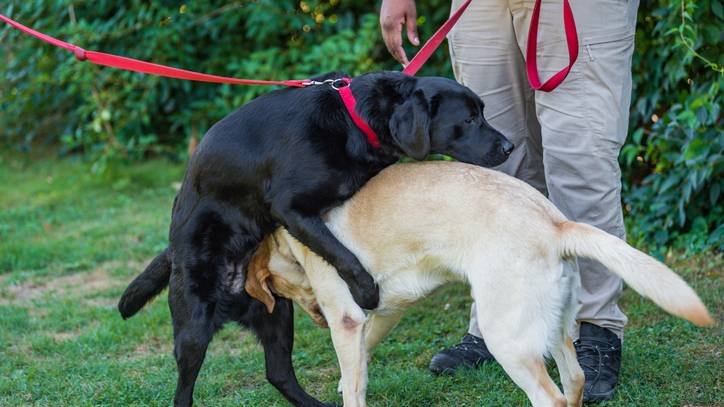
Humping can also show up during play between dogs.
This is where things can get misinterpreted. Owners often panic when they see one dog mounting another at the park, assuming it’s aggressive or dominant. In many cases, it’s just clumsy play behavior.
That said, I always advise watching closely. If the other dog seems uncomfortable—trying to move away, growling, or snapping—it’s time to step in. Not all dogs tolerate it well, and I’ve treated more than a few minor injuries that started with “harmless” mounting.
Medical Causes (Less Common, But Real)
While most humping is behavioral, I don’t rule out medical causes.
I once treated a dog whose sudden increase in humping was linked to a urinary tract irritation. Another had skin allergies that caused discomfort around the groin area, triggering mounting behavior.
If the behavior appears suddenly, becomes excessive, or is paired with licking, redness, or discomfort, I always recommend a physical exam. It’s not the first cause I suspect, but it’s one I never rule out without checking.
Common Mistakes I See Owners Make
Over the years, I’ve noticed patterns in how people respond—and sometimes unintentionally make things worse.
One common mistake is punishing the dog harshly. This often increases anxiety, which can actually lead to more humping.
Another is ignoring it completely when it’s clearly excessive. Occasional humping is normal. Constant, compulsive behavior is not.
I’ve also seen owners laugh or encourage it without realizing the long-term impact. What starts as a funny quirk can turn into a persistent habit that’s harder to break later.
What Actually Helps
From a practical standpoint, the best approach depends on the trigger.
If it’s excitement, I usually recommend redirecting the dog before the behavior starts. Training basic commands like “sit” or “place” can give them an alternative outlet.
If it’s anxiety, addressing the underlying stress matters more than the humping itself. In some cases, I’ve recommended behavioral training or even short-term calming support.
For habitual humping, consistency is key. Interrupt the behavior calmly, redirect, and avoid giving it attention.
I’ve seen real improvement when owners stay patient and consistent. It doesn’t disappear overnight, but it does get better.
Final Thoughts
Humping might feel embarrassing, especially when it happens in front of guests, but it’s rarely something to panic about. Most of the time, it’s your dog’s way of dealing with excitement, stress, or habit—not a sign of anything inappropriate or “wrong” in the way people often assume.
Once you understand the reason behind it, the behavior becomes much easier to manage—and a lot less mysterious.