
Night Vision Isn’t Supernatural—It’s Biology
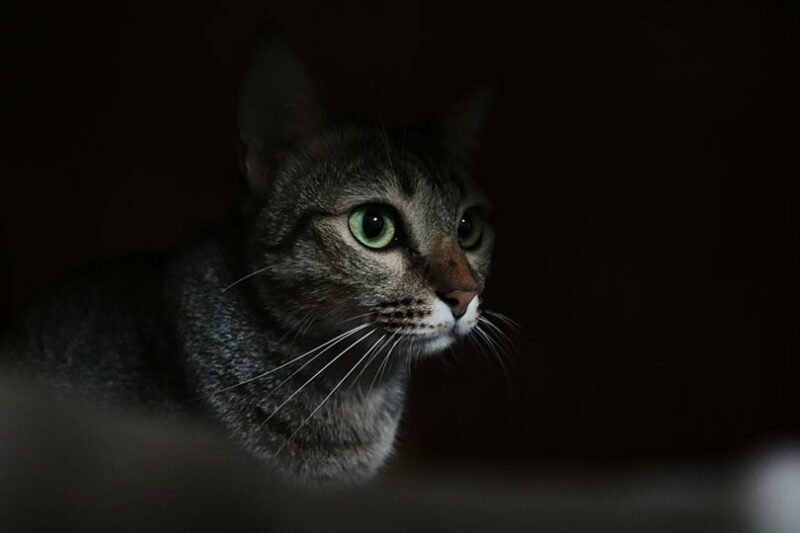
As a licensed veterinarian practicing in Texas, I’ve often been asked whether cats can see perfectly in complete darkness. The truth is nuanced. Cats are not nocturnal in the strict sense—they are crepuscular, most active at dawn and dusk—but their eyes are superbly adapted to low light.
I remember examining a seven-year-old Maine Coon named Luna during a home visit. Her owner joked that Luna “sees in the dark better than I see in broad daylight.” Watching her move across a dimly lit living room, she navigated effortlessly around furniture and even leapt onto a narrow shelf with precision.
That’s largely thanks to a high number of rod cells in their retinas, which detect light, and a reflective layer called the tapetum lucidum that amplifies available light.
How Cats Navigate Shadows
In my experience, cats can detect movement in near-darkness far better than humans. One evening, a client called me because her kitten kept swatting at what seemed like “invisible” things at night. When I visited, I realized the kitten was noticing tiny insects and dust particles illuminated by minimal moonlight. Their peripheral vision and sensitivity to motion allow cats to spot prey—or a toy—without needing bright light.
However, cats are not immune to darkness. Total, pitch-black environments without any light source still limit their vision. I’ve had clients assume their cat can wander freely in completely dark basements. In reality, I’ve seen cautious, hesitant behavior in these conditions, proving that cats rely on even faint light to orient themselves.
Color Perception in Low Light
Cats’ vision in the dark comes with trade-offs. While they detect motion and shapes exceptionally well, they see fewer colors than humans do. During an exam with a senior Siamese, I explained that cats mostly perceive shades of blue and green but struggle with reds.
This means a red toy on a dark rug might blend in, while a blue or green object will stand out—even under dim light. Knowing this can help owners choose toys or plan indoor enrichment for night-active cats.
Practical Observations from Daily Practice
Over years of practice, I’ve noticed patterns:
- Younger cats tend to move with more confidence in low light compared to older cats, who may hesitate or misjudge jumps.
- Cats in multi-level homes often memorize furniture placement, which improves their navigation in low-light conditions. One customer last fall mentioned that her senior cat could still leap to a high shelf at night without knocking anything over—a combination of memory and vision.
- Sudden changes in light can temporarily disorient a cat, just like a human stepping from a dark room into bright sunlight.
My Professional Take
Cats’ vision in low light is remarkable, but it’s not magical. They rely on a mix of highly sensitive eyes, motion detection, memory of their environment, and whiskers for spatial awareness. As a veterinarian, I advise owners to consider their cat’s age and health when evaluating nighttime agility. Older cats with eye conditions such as cataracts may struggle despite their natural adaptations.
If you notice hesitation, bumping into objects, or reluctance to explore at night, a check-up can rule out vision impairment. Otherwise, their low-light skills are one of the reasons cats often seem to “appear out of nowhere” in your living room after the lights go down—a combination of biology, experience, and instincts honed over thousands of years.