
From an Auto Detailer Who Sees the Damage Firsthand
I’ve been working as a professional auto detailer and paint protection specialist for nearly a decade. I see the aftermath of cats on cars more often than most people would believe. Evident coat scratches from tiny paws, dusty paw prints on freshly polished hoods, even dented soft aluminum roofs from bigger neighborhood tomcats — they all show up in my shop.
I like cats. I don’t like the way their claws and grit-filled paws treat car paint. Over the years, I’ve helped many customers protect their vehicles without harming animals, and I’ve tested many of the exact solutions at my own home. Some approaches work consistently; others sound clever but don’t hold up past the first few nights.
Here is what actually helps, from someone who regularly deals with real cars and real cat damage.
Why cats choose your car in the first place
Cars attract cats for simple, practical reasons.
They’re warm after being driven, they’re high off the ground with a good view of the surroundings, and they feel safe. One customer who parked beside a brick wall in a narrow driveway kept asking why the cats chose his car rather than his neighbor’s. The answer was obvious once I visited — his hood stayed warm longer because he drove later at night, and the wall created a windbreak. To a cat, that was prime real estate.
Understanding that helps you solve the problem without getting frustrated. You’re not being targeted. You’ve just got the comfiest spot on the block.

What I recommend first: change the parking conditions
In my experience, the simplest environmental changes do more than any expensive gadget.
Cats like stable, cozy, predictable surfaces. Interrupt that, and they move on. For example, I once dealt with a sedan that neighborhood cats treated like their personal bunk bed. The owner tried sprays, yelling, even tapping the hood — nothing stuck. What finally worked was parking a bit farther from the wall and pulling slightly forward so tree branches cast movement shadows from a nearby light. The cats stopped visiting because the area no longer felt tucked away and safe.
Small changes that often help:
- parking under a brighter motion light rather than a dark corner
- turning the car around so the hood is closer to open space than shelter
- avoiding habitual “same spot” parking if you have options
Cats are creatures of habit. Break the pattern, and they often reassign themselves elsewhere.
Car covers: the real-world pros and cons.
A lot of people jump straight to car covers. I’ve used them personally and seen hundreds of customers try them.
They do work, but with a catch.
They protect your paint from scratching because claws don’t directly contact the clear coat, but cheaper covers can actually rub dust and grit against your paint and cause micro-scratches worse than the cat would have left. One truck owner learned this the hard way after using a rough universal cover in windy weather. The cover flapped all night, scuffing several panels badly enough to require machine polishing.
If you go this route, I strongly recommend a soft, fitted, breathable cover, and only on a car that’s already clean. If washing your car before covering it sounds unrealistic, then this probably isn’t your answer.
Motion-based deterrents that actually stop cats
The most reliable success stories I’ve seen involve motion-based deterrents that surprise but don’t harm.
At my own house, a motion-activated sprinkler solved the problem faster than anything else. I installed it near the driveway, not because I hate cats, but because water is harmless and cats absolutely hate being surprised by it. After two or three encounters, they stopped visiting entirely and chose drier territory.
I’ve also seen customers successfully use motion-activated lights. Not all cats care about light — some barely react — but the combination of light plus open exposure often makes them uncomfortable enough to avoid the car.
I personally avoid loud ultrasonic gadgets. I’ve had multiple customers swear they did nothing except annoy dogs and small children, and they tend to end up in a drawer within a month.
Scent-based repellents: what works and what’s hype
You’ll hear everything from citrus peels to coffee grounds suggested as miracle deterrents. I’ve seen most of them tried.
Here’s the honest breakdown from real-life use:
- Citrus-based repellents sometimes help for a while, especially fresh ones
- Commercial sprays can work, but they need frequent reapplication
- Home remedies like vinegar smell awful to you long before cats stop caring
What I’ve personally had the best luck with are safe, pet-friendly outdoor repellents placed on or near the driveway perimeter rather than directly on the car. Spraying directly on paint is risky; I’ve seen certain “natural mixtures” stain clear coats or strip wax protection.
If you’re going to test a product, always try it on glass or a small painted area first.
What I strongly recommend you avoid
Because I work with cars and regularly deal with pet owners, I’ve seen approaches I wouldn’t recommend.
I would avoid:
- any deterrent involving sticky surfaces on the car itself
- toxic mothballs
- Cayenne or pepper powders that blow into animals’ eyes
- traps or anything designed to scare aggressively, rather than mildly surprise
Beyond being inhumane, these methods often backfire. Sticky mats were once used on a client’s convertible roof; he peeled one up and took the paint and fabric with it. The problem wasn’t cats anymore — it was repair bills.
Your goal isn’t punishment. It’s convincing an animal that your car is a bad place to sleep.
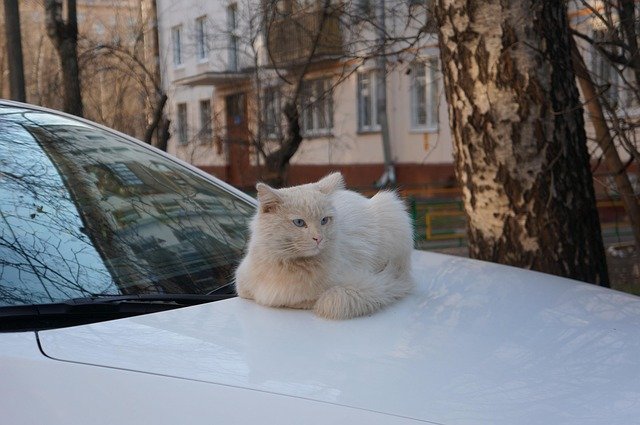
Don’t forget the under-hood issue.
I’ve also seen cats crawl into engine bays to sleep. As an auto detailer, I occasionally open a hood and find fur or muddy paw prints around the valve cover area. That’s not only inconvenient; it can be dangerous for the cat and cause real damage.
If you live in an area where outdoor cats roam, get in the habit of a quick tap on the hood or a horn chirp before starting the car early in the morning. It feels silly until the first time you realize one really was inside.
A simple combination that works for most people
If I had to recommend one practical approach based on years of watching what actually solves the problem, it would be this:
Keep the car clean and waxed so dirt doesn’t grind into the paint. Add a motion-activated light or a sprinkler, if possible. Change the parking orientation so the car no longer feels like a sheltered, hidden perch. If cats persist, move last to a quality fitted car cover.
Most of my customers who do all that stop seeing paw prints after a short while, and none of those steps harm the animals or your paint.
Cats don’t care that you spent the weekend polishing your hood, and they aren’t trying to annoy you. They’re just looking for warmth, height, and safety. Once your car no longer provides that combination, they quietly choose something else — usually without you ever seeing them go.