
A Veterinarian’s Perspective from Years in Practice
As a small-animal veterinarian who has practiced for years in regions where rattlesnakes and other venomous snakes are common, I hear this claim often: “Dogs are naturally immune to snake venom.” I can say, based on what I’ve seen in exam rooms and during emergency surgeries, they are not.
Dogs are not immune to snake venom. Some may survive a bite, but surviving a bite does not confer immunity. What many owners mistake for immunity is really luck, a dry bite, or a small amount of venom delivered. Venom varies, snakes vary, and so do dogs’ responses. Assuming a dog is protected has been one of the most dangerous mistakes I’ve watched people make.
Where the myth usually comes from
I’ve had more than one owner tell me, proudly, that their dog was “bitten before and walked it off.” In a few cases, that was partly true — the dog had swelling and discomfort, then improved without treatment. What they didn’t see was internal tissue damage that developed afterward, or the increased risk from another bite.
Venom dose isn’t consistent. A snake may inject a lot, a little, or none at all. I’ve treated dogs that were barely swollen but had significant blood-clotting problems, and others that looked terrible but recovered quickly because the bite was mostly defensive with minimal venom. That unpredictability is precisely why “immunity” is the wrong word.
What I actually see in real snakebite cases
In my experience, real-world snakebite cases follow a few familiar patterns.
One that stays with me was a herding dog brought in one summer evening. He had been fine an hour earlier, then suddenly wouldn’t put weight on a front leg. His owner thought it was a sprain. By the time they reached the clinic, the leg was twice its standard size, and the dog was becoming lethargic. Under the fur, we found two puncture wounds. Blood tests confirmed clotting abnormalities. Antivenom and hospitalization made the difference; without it, I doubt he would have made it through the night.
Another case involved a small terrier that was allowed to “deal with snakes on his own” around a rural property. He had supposedly survived a prior bite, so the owner believed he had built resistance. The next bite didn’t go the same way. He arrived in shock, his muzzle massively swollen from striking at a snake. That experience changed the owner’s mind more than any lecture I could have given.
I’ve also seen dogs bitten on the tongue after trying to grab snakes. Those cases progress fast, and airway swelling becomes the real threat. The idea of “immunity” evaporates quickly when an animal is struggling to breathe on a treatment table.
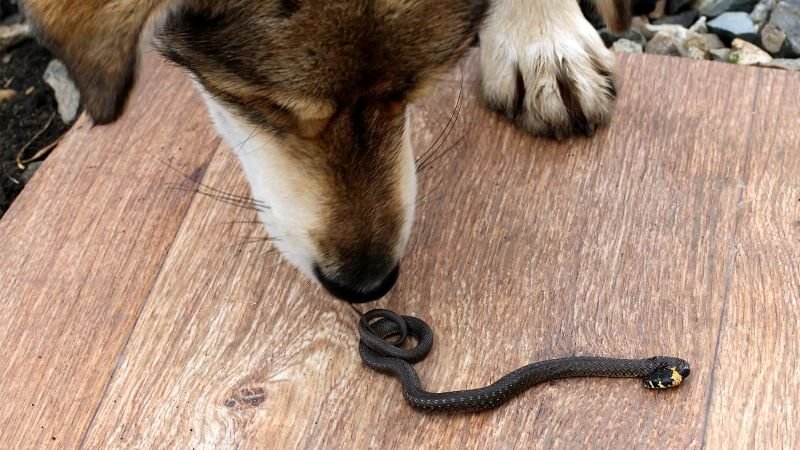
Are some dogs less affected than others?
Yes — but that’s not immunity.
Larger dogs sometimes handle venom physiologically better than tiny breeds, simply because of body mass. Some breeds seem more stoic, leading owners to think they’re handling it “well.” I’ve treated tough working dogs that barely showed pain but had severe internal effects. Behavior doesn’t match biology.
Repeated exposure also does not reliably produce resistance in dogs. I occasionally hear people compare dogs to animals like mongooses or certain snakes that have evolved specialized resistance proteins. Domestic dogs have not developed those same defenses.
What I recommend as a veterinarian
My professional opinion is blunt: treat every snakebite in a dog as a medical emergency. Don’t wait to “see how it goes.” Waiting is what has cost several dogs their lives under my care.
A few practical points I emphasize every year during snake season:
- Do not assume your dog will be okay because a neighbor’s dog once was
- Do not try to suck venom or cut wounds
- Do not give alcohol or random medications at home
- Restrict movement and get to a veterinarian as soon as possible
Antivenom can be expensive, and I understand why owners hesitate. But I’ve watched it turn dogs around within hours when their prognosis otherwise looked grim. The cost-versus-outcome conversation is one I’ve sat through many times with worried families. The regret I hear most often isn’t about the bill — it’s about waiting too long.
My honest take after years of seeing it firsthand
I’ve treated dogs that survived snakebites and dogs that didn’t. I’ve also treated dogs whose owners believed firmly that dogs were naturally protected. Those beliefs didn’t hold up in the exam room.
Dogs are not immune to snake venom. Some survive because of circumstances, not biology. The safest mindset is to assume every venomous bite is life-threatening until proven otherwise.
If your dog lives in an area where snakes are common, prevention matters more than myth. Leashes, training, yard management, and fast action after a bite save lives far more reliably than any supposed natural resistance.
That’s the pattern I’ve seen again and again, both in quiet clinics and chaotic emergency rooms.